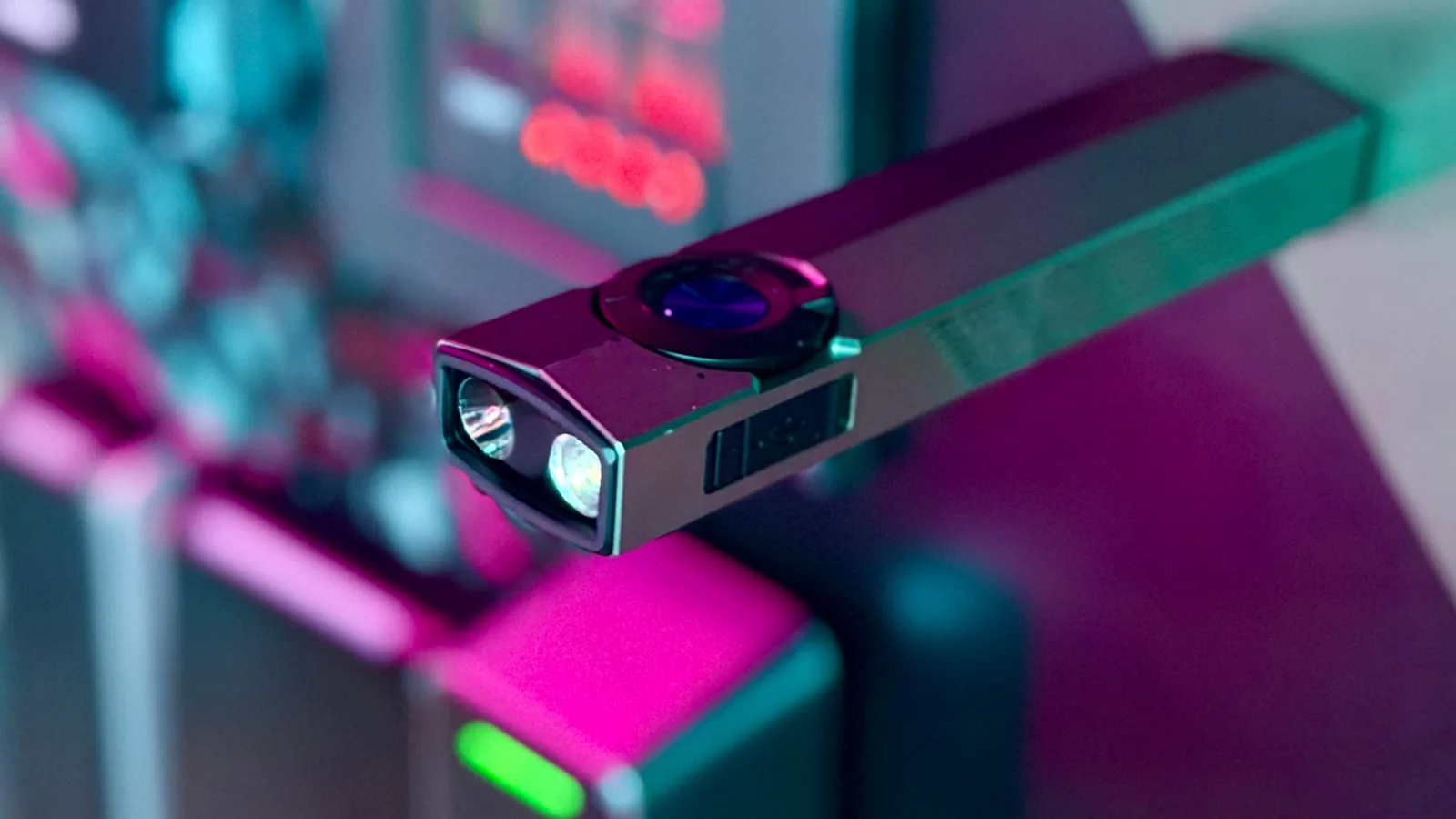
“I run the ArkPro Ultra as my own everyday carry now, and I couldn’t recommend the ArkPro or ArkPro Ultra more as an EDC light.”
Hans Study, reviewer
A flashlight earns pocket space by being available when you need it. The Olight ArkPro is designed for that role: a slim, flat EDC light that combines a broad flood beam, a focused spotlight, ultraviolet light, and a green laser.
This is not a security-only tool. The four light sources matter more than a headline lumen number, and they earn their place in almost any trade. On a security job the ArkPro lights an access control panel, identifies a camera across a room, reveals detail under UV, and points to the exact device under discussion without carrying four separate tools. Swap the vocabulary and the same holds for an electrician, a network installer, an HVAC tech, or anyone who spends their day in other people’s ceilings, risers, and closets.
The ArkPro is the perfect EDC for any field technician, not only a security one. It carries like a pen and covers four jobs a phone light cannot.
Editor’s pick: the ArkPro is our EDC Flashlight of the Year 2026.
What is the ArkPro?
The ArkPro is a rechargeable, flat-profile flashlight with four light sources. Its Pure Flood mode produces up to 1,500 lumens, while the dedicated Spotlight produces up to 800 lumens and reaches a claimed 205 metres.
The light also includes a 365 nm UV emitter and a green laser. Power comes from a built-in 2,000 mAh battery. Charging is available through USB-C or Olight’s magnetic MCC system.
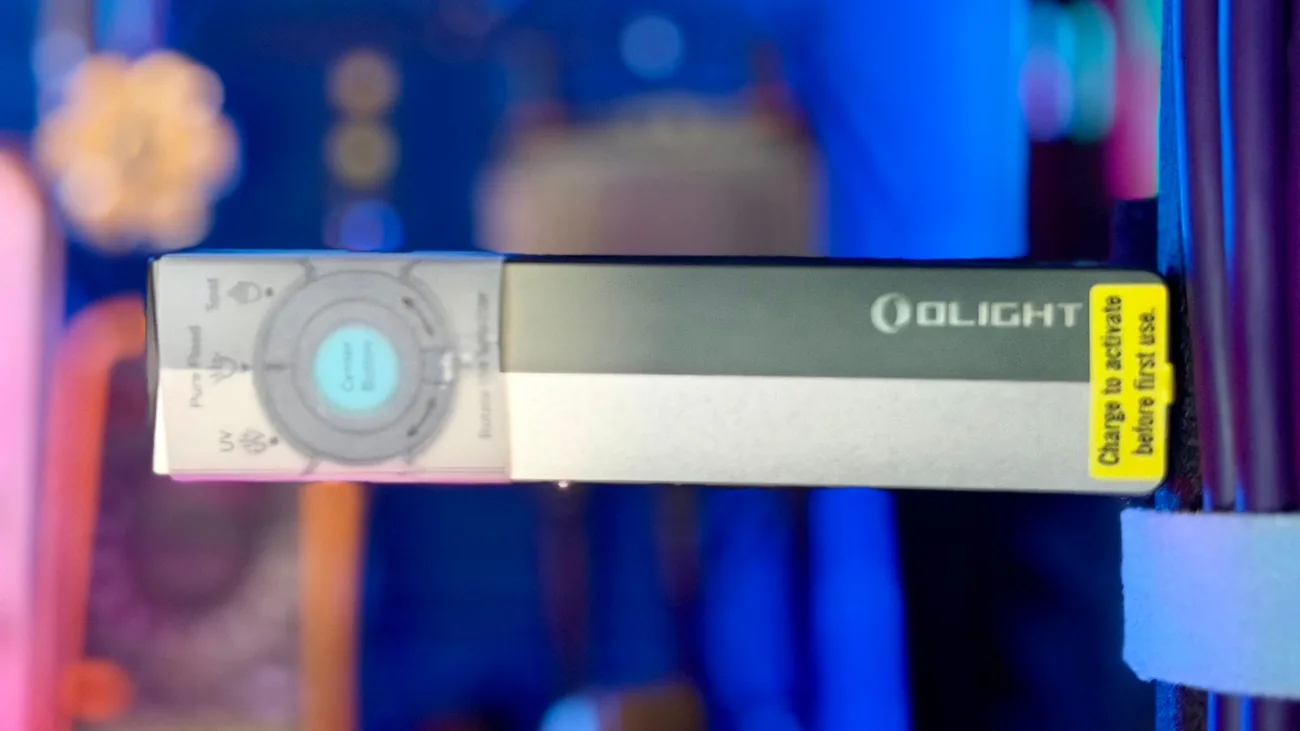
Key specifications
| Specification | Olight ArkPro |
|---|---|
| Maximum flood output | 1,500 lumens |
| Maximum spotlight output | 800 lumens |
| Maximum beam distance | 205 metres |
| UV wavelength | 365 nm |
| Laser | Green laser |
| Battery | Built-in 2,000 mAh rechargeable battery |
| Charging | USB-C and magnetic MCC |
| Body material | 6061 aluminium alloy |
| Water resistance | IPX7 |
| Drop resistance | Approximately 1 metre |
| Approximate weight | 115 g |
Published specifications and actual field performance may vary by operating mode, temperature, battery condition, and regional product configuration.
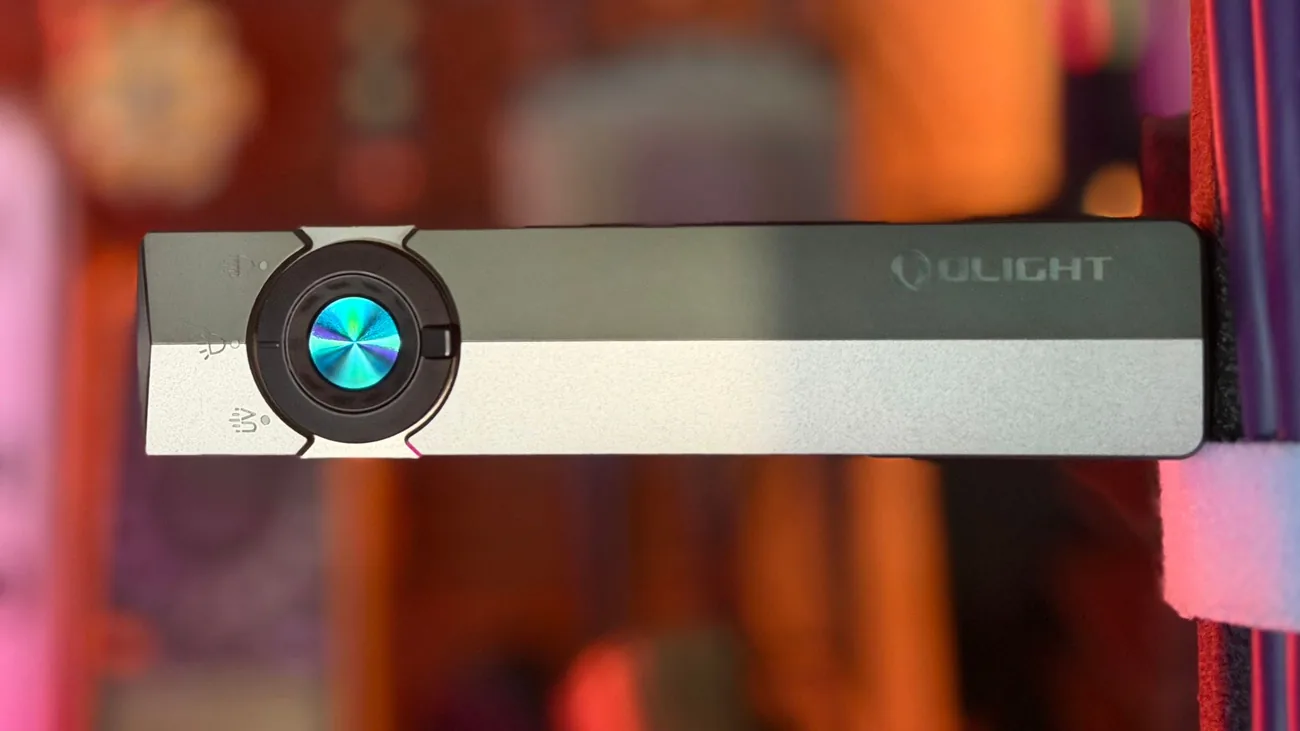
Flood beam and spotlight
The ArkPro’s most important feature is not the laser or UV emitter. It is the separation between flood and spotlight modes.
The Pure Flood beam is the mode suited to close-range work. It illuminates the area around an access control panel, reader, camera, junction box, ceiling space, or equipment rack without creating an excessively narrow tunnel of light.
The Spotlight is useful when distance matters. It can help identify a camera mounted across a warehouse, inspect the far end of a parkade, check a gate line, or locate a device down a corridor before walking toward it.
A compact light cannot sustain its maximum output indefinitely. In use the flood channel runs at full brightness for about two minutes, then steps down to a sustained level near 450 lumens that holds for roughly two hours. That is the honest way to read the rating: 1,500 lumens is a short burst, and the number that matters on a job is the sustained output, which is plenty for inspection and movement. Independent bench tests land near 1,400 lumens on the flood channel and around 750 on the spot, close enough to the rating that the shortfall never shows in the field.
Two behaviours are worth knowing before you buy. The step-downs are on a timer rather than a temperature sensor, so the light does not hold a higher level just because the night is cold. And turbo is locked out once the battery drops below roughly half charge, so the brightest setting is only available on a reasonably full cell. Neither is a dealbreaker for working use, but both are the kind of thing a spec sheet will not tell you.
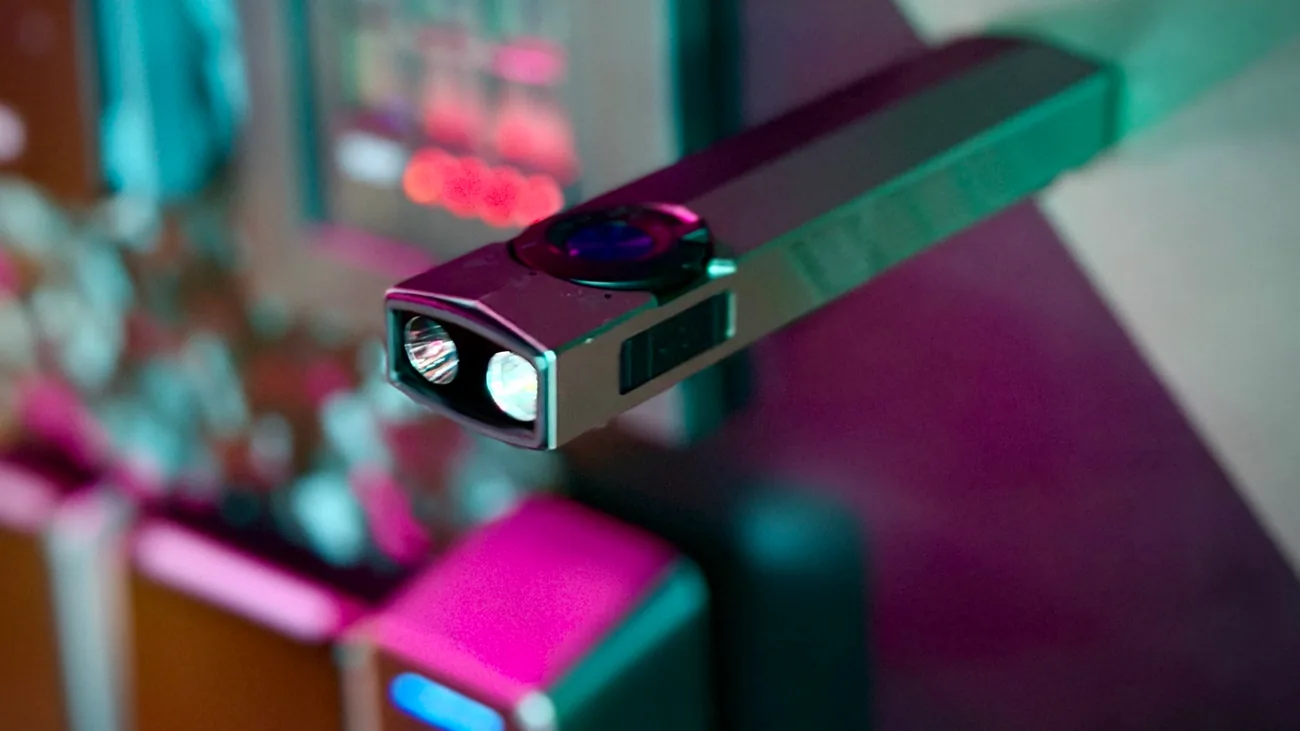
UV and green laser
The 365 nm UV emitter adds a useful inspection capability. It can reveal markings, residue, contamination, and other details that are not obvious under white light. Olight now sits the UV behind a ZWB2 filter, which blocks the visible light the emitter would otherwise leak and lifts the contrast of whatever you are inspecting. It is not a replacement for specialist forensic equipment, but it is a genuine upgrade over the unfiltered UV on the older Arkfeld line, and valuable to have in a pocket tool.
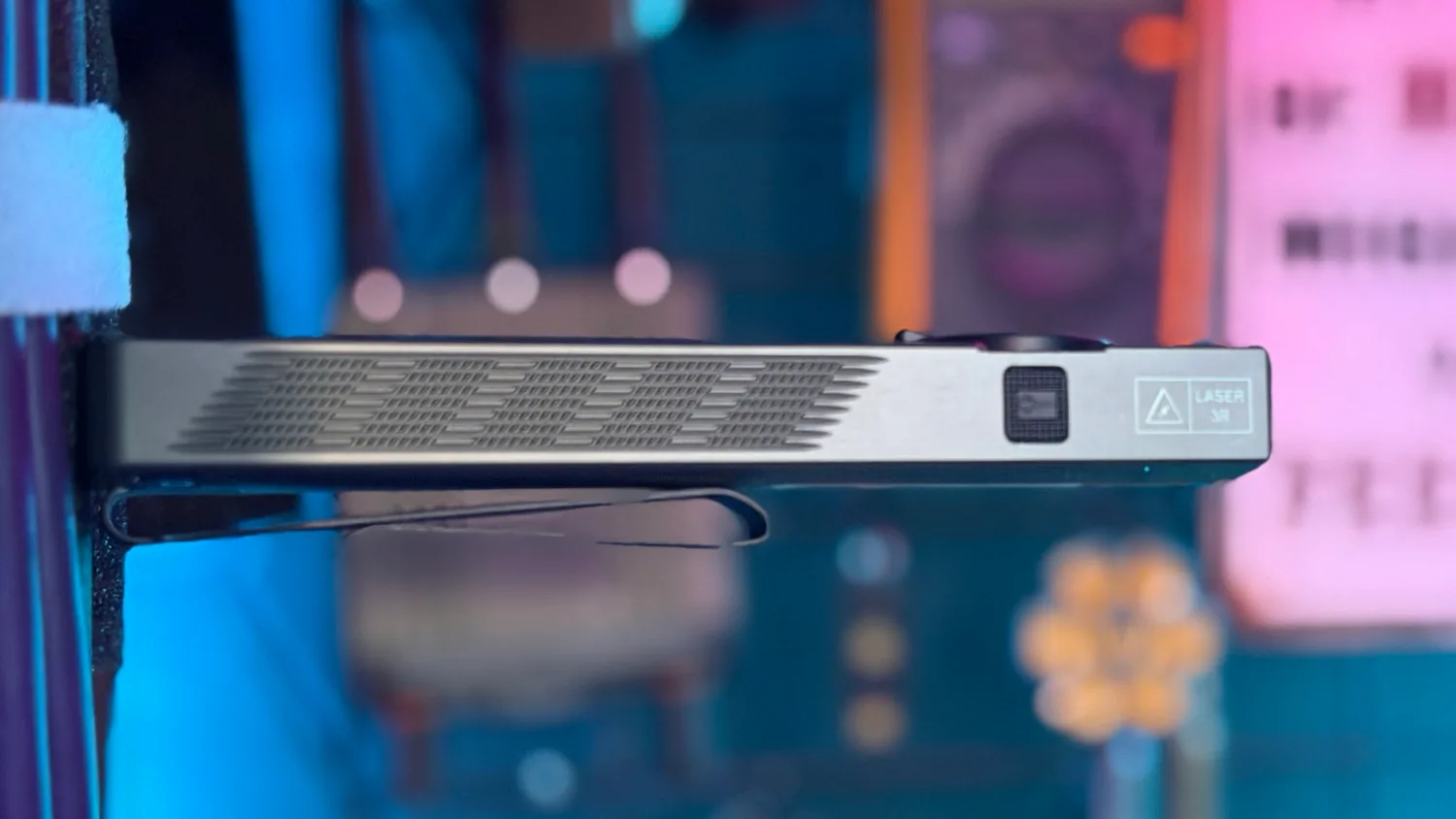
The green laser runs at two output stages, a low Class 1 level and a brighter Class 3R level. It is genuinely useful during site meetings and commissioning work: a consultant can point to a camera, reader, intercom station, mounting location, or cable route without relying on vague verbal descriptions. Be honest about its limits, though. At distance and indoors it earns its place, while up close in daylight it is closer to a novelty than a tool.
Never point the laser at people, vehicles, aircraft, or reflective surfaces where the beam could reach someone’s eyes. There is no mechanical lockout, only an electronic one, so treat the laser with the same care you would give any Class 3R device. Confirm the laser classification and local requirements before professional use.
Charging and battery
The ArkPro uses a built-in 2,000 mAh battery. The battery keeps the body compact, but it cannot be replaced in the field.
USB-C is the most convenient addition compared with older Arkfeld models. A technician can charge the light from a power bank, vehicle adapter, laptop, or the same kit used for other rechargeable equipment. The magnetic MCC cable remains convenient for desk charging and quick connection.
The fixed battery is the main compromise. Anyone working long shifts away from power should carry a USB-C power bank or plan charging between visits.
In the hand, and on a magnet
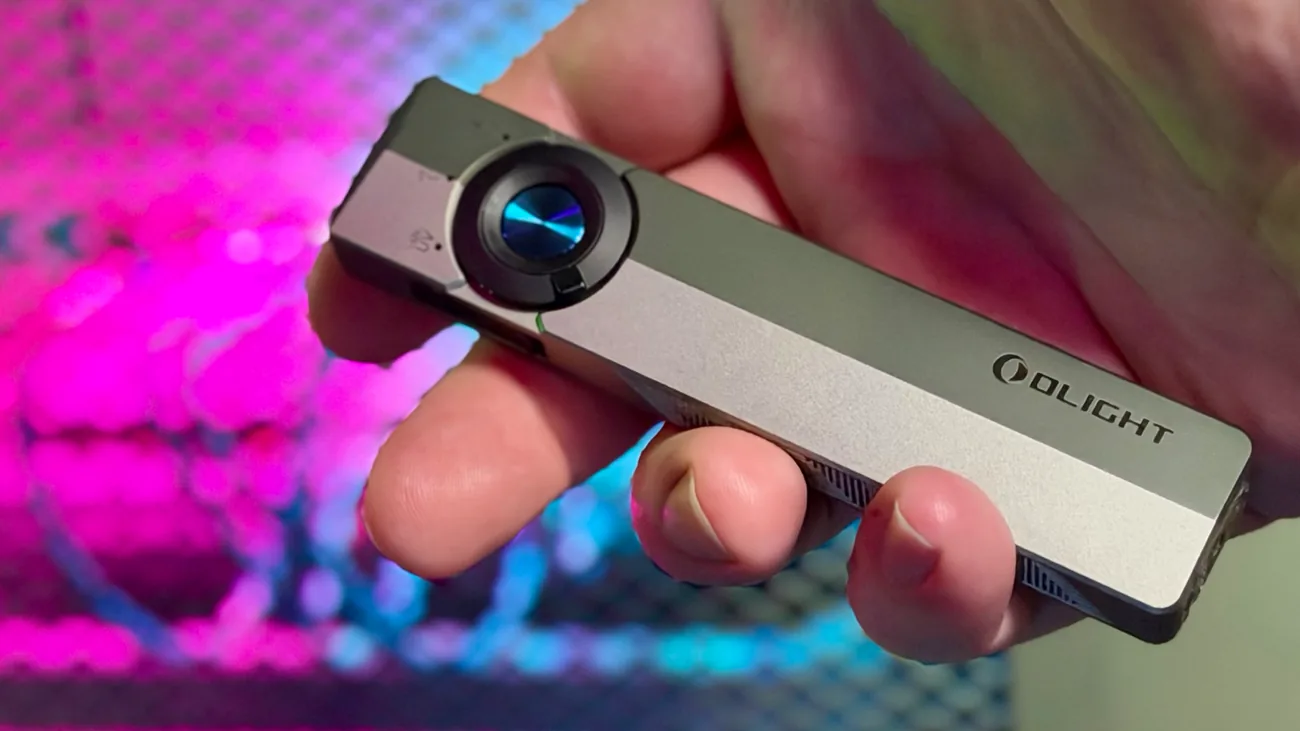
The ArkPro is one of the few lights we have carried that feels natural no matter how you pick it up. The flat body fills the palm without rolling, and it works the same whether you hold it overhand to light a workspace, reversed in an icepick grip to inspect low behind a rack, or pinched with a thumb on the tail cap to aim the spotlight. You stop thinking about the light and get on with the work, which is the whole point of an EDC tool.
It just feels right in the hand. However you grab it, the grip and the switch fall where your thumb expects them.
The tail magnet is the other quiet win. Stick the ArkPro to an enclosure door, a strut, a ladder rung, or a vehicle body and you have hands-free light exactly where you need it. For service work where both hands are busy in a panel, that beats holding the light in your teeth or asking someone to hold it for you.
The magnet has one real downside. It is strong enough to attract loose ferrous debris, so on a site with drilling, cutting, or grinding it collects metal shards, and the shallow ridges around the tail make those shards fiddly to wipe clean. It is a minor annoyance rather than a fault, but it is worth a quick pocket check before the light goes back on a clean surface.
Field use for any trade
The ArkPro fits well into work that combines inspection, troubleshooting, communication, and documentation. The examples below come from security work, but an electrician, network installer, or facilities tech reads them the same way.
- Use the flood beam while tracing a reader cable through a dark ceiling void.
- Switch to the spotlight to identify a camera across a warehouse or parkade.
- Use the laser to show a client which door, reader, panel, or intercom station is being discussed.
- Use the UV function during close inspection where markings or residue are difficult to see under white light.
- Clip the light to a pocket, vest, or bag panel so it remains accessible without opening a tool case.
The flat body also reduces the tendency to roll away on a work surface. That is a small feature, but it matters when the light is being used around panels, ladders, and equipment racks.
The clip is worth a note of its own. It is a deep-carry, two-way clip that sits the light low in a pocket, and the screws that hold it are no longer glued in place the way they were on the Arkfeld, so it is easy to move or replace.
How it compares: ArkPro, ArkPro Ultra, and Arkfeld Pro
The ArkPro is the middle option in Olight’s flat EDC line, and for most buyers it is the sensible one.
| Feature | Olight ArkPro | Olight ArkPro Ultra | Olight Arkfeld Pro |
|---|---|---|---|
| Flood output (rated) | 1,500 lumens | 1,700 lumens | 1,300 lumens |
| Dedicated spotlight | 800 lumens, 205 m | 800 lumens, 205 m | None |
| UV | 365 nm, ZWB2 filter | 365 nm, ZWB2 filter | 365 nm, no filter |
| Laser | Green (Class 1 / 3R) | Green (Class 3R) | Green |
| Battery | 2,000 mAh built-in | 2,000 mAh built-in | 1,500 mAh built-in |
| Charging | USB-C and magnetic | USB-C and magnetic | Magnetic only |
| Body | 6061 aluminium | O-aluminium (harder) | 6061 aluminium |
| Weight | About 115 g | About 115 g | About 111 g |
| Water resistance | IPX7 | IPX7 | IPX7 |
| Typical price (USD) | Around $100 | Around $130 | Around $100 |
Against the older Arkfeld Pro, the ArkPro adds a dedicated spotlight, a filtered UV emitter, USB-C charging, and a larger battery. Those four changes are the reason to move up a generation rather than buy the outgoing model on discount.
Against the ArkPro Ultra, the gap is smaller than the price suggests. The Ultra uses a harder O-aluminium body and rates a slightly brighter flood, but measured output and runtime are close, and in daily carry the two feel much the same. Unless you specifically want the toughest body Olight makes, the standard ArkPro is the better value.
Strengths and limitations
Strengths
- Useful flood and spotlight combination.
- Claimed 205-metre beam distance.
- 1,500-lumen maximum flood output.
- Filtered 365 nm UV that improves inspection contrast, plus a two-stage green laser.
- USB-C and magnetic charging, a generational win over the magnetic-only Arkfeld Pro.
- Larger battery than the older Arkfeld Pro.
- Slim, pocket-friendly design that sits naturally in the hand across grips.
- Deep-carry two-way clip with serviceable, non-glued screws.
- Tail magnet gives hands-free light for panel and service work.
- Strong fit for any field trade, not only security.
Limitations
- Not rated for hazardous locations. The laser and the sealed lithium cell mean it is not intrinsically safe, so it cannot go into classified atmospheres. A tech working oil and gas, grain, chemical, or mining sites still needs a rated light such as Streamlight’s ProPolymer HAZ-LO.
- Battery is built in and not user-replaceable.
- Maximum output is temporary rather than continuous, turbo is locked out below about half charge, and the step-downs run on a timer rather than a temperature sensor.
- High mode is not held in memory, so the light can revert to medium after a short run.
- The beam is a cool white with modest colour rendering, which is worth knowing if you inspect for colour-sensitive detail.
- The tail magnet attracts ferrous shards on cutting or drilling sites, and the ridges make them fiddly to clean.
- Standard aluminium body is less premium than the ArkPro Ultra’s O-aluminium.
- The multi-function interface takes longer to learn than a basic single-emitter flashlight.
- The light is less suitable for users who want a conventional replaceable-cell flashlight.
Reviewer’s note
About a year and a half ago I bought my first Olight EDC light, the Arkfeld Ultra. My honest first reaction was that the flat shape was a gimmick and the price was outlandish. I sat on it for a while, finally pulled the trigger, and could not have been happier. It changed how I think about a pocket light.
I now run the ArkPro Ultra as my own everyday carry, mostly for the USB-C port, and it goes everywhere with me. Whether you choose the standard ArkPro or the Ultra, I could not recommend either more as an EDC light.
Olight sent the silver graphite ArkPro in these photos as a review unit, and I want to thank them for it. As always, the loan buys hands-on time and nothing else. The assessment, the award, and the criticisms above are entirely our own.
Verdict
The Olight ArkPro is a capable professional EDC light rather than a novelty multi-tool. Its broad flood beam handles close work, its spotlight provides useful reach, the UV emitter supports inspection, and the laser improves communication on site.
The ArkPro Ultra is brighter and uses a premium body material, but the standard ArkPro retains the features that matter most in daily field work. It is the better-balanced choice for consultants, integrators, electricians, technicians, and facilities professionals who want one compact light for several jobs.
The ArkPro is a practical upgrade from the Arkfeld Pro and a more rational purchase than the Ultra when maximum output and premium materials are not the priority.
On price, the list figure sits around $100, but Olight discounts the Ark line often, and 15 to 20 percent off is closer to the real street price. Unless you need it today, it is worth waiting for one of those promotions.